Thursday, November 10, 2016

The stones

The biggest of Stonehenge’s stones, known as sarsens, are up to 30 feet (9 meters) tall and weigh 25 tons (22.6 metric tons) on average. It is widely believed that they were brought from Marlborough Downs, a distance of 20 miles (32 kilometers) to the north. 
Smaller stones, referred to as “bluestones” (they have a bluish tinge when wet or freshly broken), weigh up to 4 tons and come from several different sites in western Wales, having been transported as far as 140 miles (225 km). It’s unknown how people in antiquity moved them that far. Scientists have raised the possibility that during the last ice age glaciers carried these bluestones closer to the Stonehenge area and the monument’s makers didn’t have to move them all the way from Wales. Water transport through raft is another idea that has been proposed but researchers now question whether this method was viable.

First mention

 The first mention of Stonehenge – or ‘Stanenges’ – appears in the archaeological study of Henry of Huntingdon in about AD 1130, and that of Geoffrey of Monmouth six years later. In 1200 and 1250 it appeared as ‘Stanhenge’ and ‘Stonhenge’; as ‘Stonheng’ in 1297, and ‘the stone hengles’ in 1470. It became known as ‘Stonehenge’ in 1610, says English Heritageas

Wednesday, November 9, 2016

Remarkable ancient structure found just two miles from Stoneheng

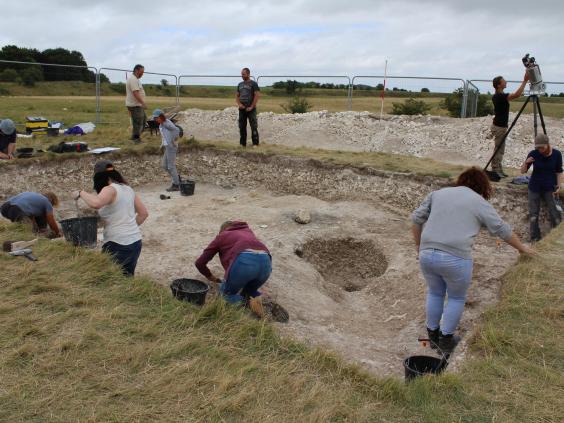
excav-1.jpg Remarkable new archaeological discoveries are beginning to suggest that Stonehenge was built at a time of particularly intense religious and political rivalry.

 Just two miles north-east of the World Heritage site, at an important archaeological complex known as Durrington Walls, archaeologists have just discovered what appears to have been a vast 500-metre diameter circle of giant timber posts. The find is of international significance.
 However, the most significant revelation is the discovery that the newly identified timber circle complex was probably never fully completed – and that, just a few months or years after construction had started, there was a dramatic change in religious – and therefore almost certainly also political – direction. Work on the circle was stopped abruptly by around 2460BC – despite the fact that it was nearing completion. The 200-300 giant 6-7 metre long, 60-70 centimetre diameter timber posts were lifted vertically out of their 1.5 metre deep post holes – and were probably used to construct or expand other parts of the complex.